Showing posts with label CRISPR. Show all posts

Tuesday, November 27, 2018

√ Crispr, Human Genetic Modification, A Needed Course Correction

Are designer babies made using CRISPR or other genetic modification technologies closer to reality today? If so, what exactly should we do about it?


Researchers can use CRISPR to genetically modify just about any organism or its cells, but targeting humans is the subject of the most intense discussion including using CRISPR in the human germline for heritable “editing” or genetic modification of humans. This could in theory be done via human embryos or human germ cells with mostly existing technology.Are designer babies made using CRISPR or other genetic modification technologies closer to √ CRISPR, human genetic modification,  a needed course correction


CRISPR studies on healthy human embryos are apparently now being conducted in the UK and Sweden by Kathy Niakan and Frederick Lanner and potentially others (see here and here) strictly for research (not reproduction).


I support the use of CRISPR for early human embryo research, but it needs to be done carefully and with proper bioethical oversight as well as transparency. To my knowledge to date, no team working on CRISPR in health human embryos has been willing to even say what genes they are targeting so that’s a masalah in my view. I would guess at least one group is aiming to knock out key pluripotency genes such as OCT4 and NANOG in otherwise normal human embryos. Will we learn dramatically more about human early embryo development that is distinct from findings in mouse embryos on the same genes? I hope so, but you never know.


We also need to realize that the moment one of these studies on intentional genetic modification of healthy human embryos is published there is a good chance there will be a political firestorm in response from some quarters. This is in part why seemingly pro-heritable human modification arguments popping up need to be responded to and discussed as even the strictly research-focused CRISPR work in healthy human embryos will lead to invocations of germline human modification.

Sunday, November 25, 2018

√ Postdoc Job Opening: Cancer Stem Cell Epigenomics Knoepfler Lab


funded postdoctoral fellow position in the Knoepfler Lab at UC Davis School of Medicine is √ Postdoc Job Opening: Cancer  Stem Cell Epigenomics Knoepfler Lab
UC Davis School of Medicine

An NIH and foundation-funded postdoctoral fellow position in the Knoepfler Lab at UC Davis School of Medicine is open. The focus of research will be on cancer and stem cell epigenomics. Studies will include functional genomics assays such s ChIP-Seq, chromatin configuration, CRISPR genetics work, and cell biological research.


Qualifications:

Applicants must have a PhD, an MD, or both. Preference will be given to applicants who do not already have postdoctoral experience, but who have a strong track record as graduate students of biological research including publication of their work. Genomics, next generation sequencing, bioinformatics, cancer biology, and/or stem cell experience would be a plus. Excellent written and oral communication skills are required.


To apply: E-mail knoepfler@ucdavis.edu a 1-page overview of research experience and career goals, a CV, and contact information for 3 references.


Sumber aciknadzirah.blogspot.com

Sunday, November 18, 2018

√ In First For U.S., Mitalipov Reportedly Crispr’D Human Embryos It Was Great

More CRISPR’d human embryos, but this time in America?


MIT Tech Review is reporting that Oregon scientist Shoukhrat Mitalipov has used CRISPR on human embryos in his lab in the US. Apparently a paper is in the works on this. has used CRISPR on human embryos in his lab in the US √ In first for U.S., Mitalipov reportedly CRISPR’d human embryos  it was great


While details are sketchy and some specifics remain to be clarified to be sure of what’s the deal here, this Tech Review report appears generally accurate based on what I’ve heard so this appears to be the first reported use of CRISPR on human embryos by an American lab.


Boom, the door is open.


Based on the little we know and rumors out there, it appears likely that Mitalipov’s team, while creating embryos from sperm of men with genetic disease, used CRISPR on otherwise healthy, viable embryos, but that remains to be confirmed.


Tech Review seems to be gushing a bit too much for my taste though on this CRISPR’d human embryos development and making some pretty big assumptions about how it turned out. For instance, this quote sounds like hype to me:


“Now Mitalipov is believed to have broken new ground both in the number of embryos experimented upon and by demonstrating that it is possible to safely and efficiently correct defective genes that cause inherited diseases.”


Safely and efficiently?


Isn’t that “safely” part jumping the gun? You’d have to make a person from the CRISPR’d human embryos to really know if it was safe or not.


Apparently as to the latter claim of “efficiently”, Mitalipov’s team reportedly used CRISPR on “tens” of human embryos and reportedly found better efficiency and lower rates of mosaicism, where down the developmental path days after CRISPR introduction only some cells have edits, while others don’t.


Let’s wait for the data. Also, I’d recommend reading my ABCD plan for handling human genetic modification research, which suggests being transparent about the genes being targeted for one thing.


The US National Academy’s panel on human gene editing outlined many reasons for caution on the use of CRISPR in human embryos but left the door ajar and now Mitalipov seems to have gone through. Since federal funding of embryo modification isn’t clearly allowed in the US, presumably this team used private funding of some kind.


Overall, is this development a good thing?


It’s a mixed bag. I’ll reserve more definitive judgement until the paper is actually published and we can all discuss it. However, it is very important not to hype the use of CRISPR in human embryos as an easy or safe path to preventing genetic disease, and also to point out the existing proven technologies of embryo screening (PGD, PGS) that could be used instead right now to achieve almost all of the same goals.


Meanwhile researchers in China are reportedly doing more CRISPR on human embryos, and researchers in the UK and Sweden have apparently already been CRISPR’ing healthy human embryos based on their respective governmental approvals…strictly for research purposes.


What comes next?


Sumber aciknadzirah.blogspot.com

Saturday, November 17, 2018

√ Who Leaked Mitalipov Crispr Human Embryo Paper?

The new CRISPR human embryo paper from Shoukhrat Mitalipov is stirring things up, but then there’s also the murky back story as to how the news of this as yet unpublished paper got leaked in the first place. The actual paper is still not out and from what I understand hasn’t even been officially released by Nature in embargoed form to journalists. So what the heck happened?


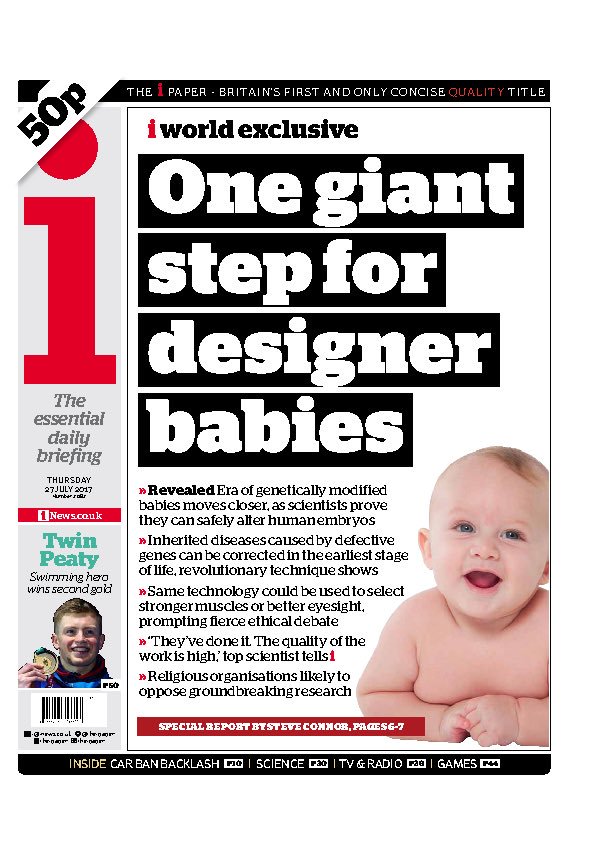
Specific details of the Mitalipov paper popped up a couple of days ago on Tech Review and on a UK news outlet (both by the same author, Steve Connor) perhaps as much as a full week before the paper is set to come out. Leaks at the White House and leaks in science?


You can see the “iNews” front page at right. Connor’s piece in Tech Review in my view was a bit too upbeat about the manuscript in terms of “safety” in particular, but I haven’t even seen the manuscript so I can’t be sure and Connor’s scoop on this admittedly was interesting. I’m excited to read the actual CRISPR human embryo paper too and without it much of what is out there remains somewhat unclear.The new CRISPR human embryo paper from Shoukhrat Mitalipov is stirring things up √ Who leaked Mitalipov CRISPR human embryo paper?


We all want to know more about the data, but many seem now to be asking the same kind of bigger picture question too, ‘who leaked it?’


In his iNews piece, Connor quotes at least one anonymous source:


“Although Mitalipov and his colleagues are under a strict confidentiality agreement with a leading scientific journal, which has scheduled to publish the work next month [August], we understand from other sources that the study breaks new ground in demonstrating the feasibility of creating genetically modified babies. “I’ve heard Mitalipov has done it. He’s successfully done genetic modification of human embryos. The quality of the work was high,” said one senior scientist who wished to remain anonymous.”


Connors also quoted a Salk Institute scientist, apparently a co-author with Mitalipov, by name about the paper in the Tech Review piece:


“Reached by Skype, Mitalipov declined to comment on the results, which he said are pending publication. But other scientists confirmed the editing of embryos using CRISPR. “So far as I know this will be the first study reported in the U.S.,” says Jun Wu, a collaborator at the Salk Institute, in La Jolla, California, who played a role in the project.”


I asked myself, “How would anyone know to contact this one particular person Jun Wu regarding an unpublished paper not even released by the journal in the first place?”


It’s also notable that Connor’s quote says “scientists” as in plural.


The apparent fact that Nature has not even officially released embargoed copies of the paper to the press and won’t do so until early next week  means that no embargo was broken since no embargo yet exists (weird situation, huh?), but something unusual happened here.


I reached out to Connor, but he was unable to discuss sources regarding this story, which is totally understandable.


Does it really even matter if an important science paper or its key findings are leaked out a few days or a week in advance? If it does matter (and gut feeling is that it does on some levels), what are the risks to science and scientists? Or is it more about the journal itself maintaining control of the timing and the initial media coverage?


What do you think?


Sumber aciknadzirah.blogspot.com

√ Big 5 Questions Anticipating Mitalipov Human Embryo Crispr Paper

The human embryo CRISPR paper with Shoukhrat Mitalipov as senior author is coming soon √ Big 5 questions anticipating Mitalipov human embryo CRISPR paper
Modified open Wikimedia image

The human embryo CRISPR paper with Shoukhrat Mitalipov as senior author is coming soon.


It will reportedly be focused on the use of CRISPR to genetically modify viable human embryos for reversal of a disease-associated mutation. While strangely press already broke early on this paper last week, as much as a week before the paper comes out, and that press suggests very positive data, how clear will that be from the paper itself?


Here are some ideas on the big 5 questions (some include nested questions) likely to come up from this now eagerly-anticipated paper:


  • 1. How much residual off-target activity was there and if it was very low, how was that achieved? How low does it have to be where someday this hypothetically could be used for actual reproduction with a strong expectation of safety and efficacy? Was WGS done on many embryos to look comprehensively for unpredicted off-target activity?

  • 2. At the sasaran site, were indels ever created instead of the desired precise edits?

  • 3. Is the goal of Mitalipov and the larger team on this paper to actually use this approach in the germline for heritable human gene editing within say 5 years? If so, how will it be limited to just that and not other applications such as infertility or trait modification? What kind of ethics review went into this paper and how does it compare to the NAS report on human gene editing?

  • 4. Will others use this paper as a foundation to argue for a more permissive policy on human germline edits?

  • 5. And/or conversely will there be a political reaction here in the US (and maybe elsewhere) leading to restrictions on human CRISPR research or other areas of innovative research in the US?


Note: this post was written prior to my seeing the human embryo CRISPR paper.


Sumber aciknadzirah.blogspot.com

Friday, November 16, 2018

√ Review Of Mitalipov Paper Crispr’Ing Human Embryos: Transformative Work On The Edge

In the same way perhaps that some excited relatives or parents-to-be both gush and worry about a baby before it is even born, our field has been transfixed for a week by the Mitalipov paper on CRISPR’ing human embryos even though the paper just now came out.


In the same way perhaps that some excited relatives or parents √ Review of Mitalipov paper CRISPR’ing human embryos: transformative work on the edge
Figure 3a Ma, et al. Nature, 2017

Now that the paper is out, we can take a closer look at this “baby” and for us scientists that involves giving it a critical review. In science, “critical” often means a thorough once over with a somewhat skeptical eye, but not necessarily a negative one. Indeed, my overall take on this paper is positive. It is quite strong technically and has many elements that are innovative even though 3 previous studies have already tried CRISPR gene editing in human embryos of various kinds.


This new paper “Correction of a pathogenic gene mutation in human embryos” is in a different category than the other ones in its approach and implications. It is quite rigorous and contains generally very thorough analyses. There are still some very important open questions and I believe there are some issues with perhaps some small overstatements, but by and large this paper is top-notch.


What are the key take homes from this study? Let’s look at my big five questions and now some attempts at answers.


  1. Off-target activity? They didn’t detect any. Overall some statements in the paper are perhaps a bit overexuberant such as statements of “abolished mosaicism” (they actually did find a mosaic embryo). I also do not believe they can be quite so confident about “no off-target activity”, when as best as I can tell they did not look thoroughly in enough embryos and cells and in an unbiased manner at the whole genome to really be sure about this. Still their finding of no detectable off-targets so far is impressive.

  2. Indels? The Indels present at the sasaran locus even under ideal circumstances in just under 30% of embryos are a big deal and remain a major problem. See part of Figure 3A above in the experiment where they found the 27% of embryos having Indels.

  3. Clinical intent overall and NAS report on human gene editing? These folks make no bones about their hope to one day use this kind of technology for human reproduction with specific clinical goals. While they also included some appropriately cautionary statements about future clinical use, at the same time some language such as envisioned possible “rescue” of embryos was potentially concerning. I am highly skeptical that gene editing in the human germline can make sense as a safe and more effective approach than embryo screening by PGD and PGS.

  4. Will this paper embolden others to dive in to this space too? Perhaps it will catalyze more research on CRISPR in human embryos. That could be both good in the sense of learning more, but also risky in terms of not everyone doing such a good job as these authors did in considering ethical implications and even in the technological level they used. Also, where will everyone get eggs and sperm for studies?

  5. Will this paper lead to a negative, perhaps political reaction? I do think it is better than 50-50 that there will be some kind of political reaction from conservatives about this development and possibly some kind of proposed restrictions.


And more questions pop up now that I’ve read the paper.


10,000 eggs or embryos? What if to get to a clear answer on whether this technology is safe and effective it takes 1,000 or 10,000 human embryos, and hence eggs? CRISPR’ing human embryos at that scale might be needed to get clearer answers on efficacy and safety. Does the hypothetical potential benefit of pursuing human germline editing justify that? These are not every day run of the mill cells. Procurement and use of human eggs and embryos requires extra consideration.


What about epigenetics? Does CRISPR’ing human embryos lead to epigenetic effects that have biological outcomes, some of which may be negative?


Flying blind OK? Another thing to keep in mind is that if this technology were taken in a reproductive direction, you could not analyze the embryos in depth like they did in this paper. You’d have to largely fly blind. At best you could pluck a few blastomeres off for analysis, but you have to leave most of the embryo behind to actually get a baby.


Overall, this is an impressive paper, but one that also raises the stakes on future CRISPR use in humans.


Sumber aciknadzirah.blogspot.com

Thursday, November 15, 2018

√ 4 Key Reasons Mitalipov Paper Doesn’T Herald Safe Crispr Human Genetic Modification

We can be confident that human genetic modification via CRISPR’ing of embryos soon will be safe and effective after that new exciting Mitalipov team paper, right?We can be confident that human genetic modification via CRISPR √ 4 key reasons Mitalipov paper doesn’t herald safe CRISPR human genetic modification


Wrong.


The reality is far more complicated and interesting on the tech side.


In a nutshell, I see the paper as a significant scientific, but not necessarily medical advance.


The media coverage overall has painted too rosy and simplistic a picture of the Mitalipov paper. Setting aside tough bioethical and societal issues regarding human genetic modification for the moment in this post, there are 4 major, mostly overlooked technical reasons why the Mitalipov CRISPR human embryo paper is unlikely to herald safe human genetic modification.


1. I dream of Gene-y. The “best” disease-associated gene to sasaran with CRISPR in humans would be one that CRISPR always “hits” perfectly. The Mitalipov team probably gave deep thought to picking the gene they did for CRISPR targeting. It’s a gene going by the name MYBPC3 that is associated with a fatal type of heart defect called familial hypertrophic cardiomyopathy (HCM). That disease association is an important reason for trying CRISPR on the mutation in this gene. However, most likely at least one big technical reason they chose MYBPC3 was because it had so few predicted possible CRISPR off-target sites (meaning other places in the genome found by computer algorithms that CRISPR might stray to and make damage). If I’m right about this, then they were just being smart in that choice and I would have probably done the same thing in their shoes. But the targeting of this hand-picked gene means that the upbeat findings on accuracy with reverting mutant MYBPC3 are probably unlikely to be representative of efforts to “gene edit” disease-causing mutations more generally. By analogy would you like to throw a dart at a dartboard where the bull’s-eye takes up fully two-thirds of the dartboard (MYBPC3?) or where the bull’s-eye is just one thirtieth (some other disease-causing mutations)? For many diseases you may in effect have no choice but to go for the far tougher bull’s-eye because of the nature of the particular gene and its disease-associated mutation.


Isn’t it possible for all major disease-associated gene mutations that CRISPR will work as well (or even better) than MYBPC3? Nope, that’s not the way the real world works unfortunately.


In fact, one of the authors (Jin-Soo Kim of the Institute for Basic Science in Daejeon, South Korea) specifically emphasized to Nature News the low predicted off-target rate of this gene:


“Even so, Kim notes that the CRISPR–Cas9 error rate can vary depending on which DNA sequence is being targeted. The MYBPC3 mutation, in particular, was predicted to produce relatively few opportunities for off-target cutting.”


It is also possible the team picked MYBPC3 because its mutation is very small (only 4 base pairs and in theory easier to repair) or they had the human sperm donor lined up with this mutation.


A combination of factors most likely guided the team in gene choice.


Other gene mutations are going to be far tougher because they will be prone to dramatically more off-targets (see below) and perhaps more Indels (see below). Many mutations are large and complicated as well.


2. Off targets there, but not oft found? There’s also the likely possibility that the team unintentionally missed finding some off sasaran effects of CRISPR that were in their modified embryos, but not found because of how they did the sequencing. The very next quote in that Nature News piece is from Keith Joung on this concern:


“Just because the team did not find off-target changes does not mean that the changes aren’t there, cautions Keith Joung, who studies gene editing at the Massachusetts General Hospital in Boston. “Although this is likely the widest examination of off-target effects in genome-edited human embryos performed to date,” he says, “these investigators would need to do much more work if they wanted to define with certainty whether off-target effects do or do not occur in this context.”


Give the Mitalipov team credit for the screening they did do, which was relatively a lot, but much more is needed to be even close to sure about this, especially if one has clinical hopes as this team does.


3. Indel pain in the neck. The metaphor behind the language and concept of “gene editing”, the preferable phrase to “genetic modification” within the scientific politics of today (admittedly I sometimes use this phrase myself), suggests precision changes as do other metaphors like “genome surgery”. However, even if CRISPR-Cas9 avoids off-targets and sticks to the gene of interest, it can often make these things called “Indels” short for insertions and deletions right in sweet spots in genes. Indels often functionally kill genes entirely rather than precisely changing them. The Mitalipov team found Indels more than 1/4 of the time in embryos even under their most optimized conditions. The rate of Indels needs to be at or very close to zero to begin to have any reasonable chance of clinical safety of using CRISPR in the human germline. Plus, at other mutant genes that may be targeted in human embryos, Indels may be much more commonly created by CRISPR than at MYBPC3. We just don’t know.


4. Mosaic monitor. Mosaicism with CRISPR is where the cells of the embryos after introduction of CRISPR-Cas9 machinery don’t all have the same genome any more. For example, some cells in the same embryo may be normal and some mutant. There’s a genomic gemisch. That’s generally not good for ultimate health so mosaicism would be unsafe for hypothetical clinical applications of CRISPR in humans. One of the most impressive things about the Mitalipov CRISPR embryo paper was that they reportedly got rid of most (just 1 mosaic found) mosaicism in CRISPR’d human embryos. However, this was essentially just a very narrow test case study with one male sperm donor and one or a few women who donated eggs. Thus, the embryos used were very similar. More broadly, there is likely to be substantial variability in propensity to embryo mosaicism in part related to the unknown characteristics of specific gamete donors.


PGD reminder. Beyond the technical challenges, the fact is that almost anything CRISPR could do of medical use heritably in humans is already achievable using embryo screening including by the common, proven method called PGD. Think of it this way by analogy. Let’s say you have 8 books with 4 having errors and 4 not having errors. You have a very reliable way to know which books are which, and you only need 1 correct book. Do you try to correct the 4 errant books knowing that you could easily make more errors yourself in trying to fix the error, or just pick from one of the easily identifiable perfect ones?


Bottom line. For all these reasons, we should all be more cautious in making meaning from this one paper. There’s a long tough road ahead with a marathon of challenges (and the authors rightly acknowledged many of these so kudos to them) if one has clinical aspirations for CRISPR in the human germline.


Sumber aciknadzirah.blogspot.com

Tuesday, November 13, 2018

√ Crisprcon Guest Post: Hope For A Brighter Future

By Anna Everette


 we have an addiction to vertical genetic transmission √ CRISPRcon guest post: Hope for a brighter future
Anna Everette

“In our society, we have an addiction to vertical genetic transmission. It’s called sec and having a child who looks like you”.


This was perhaps the most memorable quote from the event’s keynote speaker, Greg Simon, Director of the Biden Cancer Initiative. It also happens to highlight the most compelling reason to pursue this exciting technology.


CRISPRcon took place on August 16-17 at the UC Berkeley and was meant to encourage communication about the range of ethical and social implications surrounding the use of CRISPR in different fields, from agriculture to medicine.


Many people came to the event to share their thoughts, hopes and fears related to the use of gene editing. we have an addiction to vertical genetic transmission √ CRISPRcon guest post: Hope for a brighter future


Many people seemed to be unable to decide how they felt about it.


 we have an addiction to vertical genetic transmission √ CRISPRcon guest post: Hope for a brighter future


And I’m sure that many people found at least some of their views gradually changing throughout the course of the event.


Personally, I’ve been fascinated with the concept of gene editing ever since I first read about it. Although I was in middle school at the time and it was more in the realm of science fiction rather than a scientific prospect, I couldn’t stop thinking how much it could contribute towards happier, healthier lives.


But as this technology began to develop, while it was met with excitement from one group of people, there was also distrust and sometimes hostility from the other. Michael Specter, staff writer of The New Yorker and the author of Denialism: How Irrational Thinking Hinders Scientific Progress, Harms the Planet, and Threatens Our Lives, made an excellent point while participating in a discussion panel: “It’s easy to write stories that will scare the crap out of people”. Indeed, a scary story holds an undisputable allure, particularly in the case of CRISPR: if we perceive it as a genuine threat that will bring chaos, divide and discrimination then by not allowing it into our lives we get to be the heroes. And being a pendekar fighting for justice has never been so easy.


“Can polio vaccines give you polio? Yes, if they’re not made right”. Coming back to the keynote speech, this slide sums up how dangerous and deconstructive the “what-if” kind of thinking can get, and why we must not allow ourselves to get caught up in it.


 we have an addiction to vertical genetic transmission √ CRISPRcon guest post: Hope for a brighter future


Doubt is permanently connected to self-preservation, and it makes us cautious — which is a good thing. But it can also become a paralyzing, destructive force. Ask any person who desperately needed to make an important decision, but hesitated long enough and missed their shot — they’re likely to have at least one regret in life.


Sure enough, when we’re deciding the fate of CRISPR, we’re not deciding this for us but for our children — or possibly grandchildren — which means enormous responsibility. Which automatically means categorizing the issue under “proceed with caution”. However, moving slowly shouldn’t mean not moving at all. I believe there’s a real danger for this tech to be stuck in regulatory limbo, possibly to a point where there will no longer be an opportunity to use it — it is extremely difficult to make predictions in current climate. So let’s aim to give the next generation best possible start in life. They will have plenty of challenges ahead.


Anna is a freelance writer with a keen interest in biotechnology, follow her on twitter @annaeverette16 or email her at anna [at] endthread [dot] me.


Sumber aciknadzirah.blogspot.com

Friday, November 9, 2018

√ Doubts Raised On Key Points Of Nature Paper On Crispr Gene Editing Of Human Embryos

Is it possible that CRISPR gene editing actually didn’t happen in many of the human embryos in that big Nature paper that made such news a couple weeks back?


Some doubts have emerged that call the main conclusions of the paper into question and argue that more definitive studies are needed to be sure.


Is it possible that CRISPR gene editing actually didn √ Doubts raised on key points of Nature paper on CRISPR gene editing of human embryos
Egli, et al. preprint Fig 1e-f

An international team of top scientists led by first author Dieter Egli has responded via a preprint on Biorxiv to that Mitalipov team high-profile Nature paper on CRISPR gene editing of human embryos. Egli, et al. raise the possibility that the CRISPR gene editing as reported in the Nature study may actually not have happened, at least not in every case and perhaps not the way the Ma, et al. paper argued it did (via homology directed repair (HDR)-based CRISPR-Cas9 action specifically depending on interaction between normal maternal and mutant paternal chromosomes).


On one level it isn’t so unusual to see a scientific critique of and technical questions raised about a published paper that made splashy news. However, I see this particular case as a striking turn of events because although the new Egli, et al. piece is very collegial and diplomatic, they convincingly lay out a number of rather compelling reasons why the main conclusions of the Ma paper might be incorrect and the reasons why there may not have been CRISPR gene editing in many of the embryos. To be clear, Egli and colleagues don’t seem to be saying the Ma, et al. paper is definitely wrong, but they describe some quite reasonable ways in which the Ma paper could hypothetically have inadvertently reached incorrect central conclusions. To me these possible alternative explanations just simply make a lot of sense and are things that should have been ruled out as alternative explanations.


The preprint author group includes highly respected scientists (Dieter Egli, Michael Zuccaro, Michal Kosicki, George Church, Allan Bradley, and Maria Jasin) and the questions they raise should be taken seriously. On my first reading of their well-written piece, I was already convinced that their concerns may be valid. Early on in the piece they write this:


“Considering the data presented in Ma et al., alternatives to recombination between homologues are possible and would seem more likely, as the cell biology of fertilized eggs would appear to preclude the direct interaction between the maternal and paternal genomes required for inter-homologue HDR. Therefore, clear evidence for a novel linkage of maternal and paternal alleles is an imperative for any embryo that would be considered for future implantation.”


What are the main issues articulated in the Egli paper that raise at least some doubts about the main conclusions of Ma, et al. paper?


First, the Ma paper makes the unusual argument that HDR-driven gene editing occurred after CRISPR-Cas9-induced DNA breaks in the mutant paternal allele essentially exclusively using the normal maternal chromosome as a template within the same 1-cell embryo rather than via an introduced synthetic template. In fact, in some of the Ma paper’s studies no template was included so that CRISPR-Cas9 gene editing had to rely on endogenous DNA in the embryo for HDR. However, Egli, et al. point out that this is exceedingly unlikely because the male and female pronuclei are entirely physically separated in the 1-cell embryo (Figure 1e-f above). How could the maternal and paternal chromosomes have physically come together to mediate this HDR during meiosis? Hypothetically possible? I suppose, but it’s hard to imagine a likely mechanism.


What about HDR later during mitosis? This is theoretically possible as the preprint notes the maternal and paternal genomes come together at that later time: “Merging of maternal and paternal chromosomes does not occur until microtubule action assembles both genomes on a common metaphase plate at the first mitosis…direct interactions between maternal and paternal genomes required for inter-homologue repair do not seemingly occur until embryos enter the 2-cell stage when the two genomes are packaged within the same nucleus.” If gene editing via HDR did occur much later during mitosis (but note that such recombination is thought to occur much less frequently during mitosis than meiosis), the Mitalipov team should have seen dramatically more mosaicism. Importantly, in addition if the gene editing only took place that late, why would they have observed such an apparently large difference in outcomes between MII and zygote injections?


Second, Egli, et al. point out the potential risks of relying as the Ma team did for some assays just on the apparent absence of a detectable mutant allele. Concerningly, there are a number of reasons other than CRISPR gene editing of a mutant allele back to wildtype that could more simply explain why no mutant alleles were detected. The Egli piece argues that one such possibility that wasn’t ruled out is the presence of moderate-to-large deletions resulting from CRISPR activity and eliminating primer binding sites, leading to no amplification of mutant alleles. This may in theory result in only WT alleles being detected leading to the potential incorrect conclusion of gene editing reversion of mutant alleles, when in the fact in that scenario the altered (not repaired) mutant alleles are there but just not detectable.


The preprint mentions unpublished data that such large deletions occur with CRISPR gene targeting in around 20% of gene edited cells. Sequencing to conclusively rule out Indels as a cause of failure to detect mutant alleles in various embryos or cells could be very difficult for a variety of technical reasons, but it could be done. I’m not clear as to whether the extent of genome sequencing in the Ma, et al. paper was enough to be sure.


Third, another alternative possibility discussed is that there sometimes was no contribution of the paternal genome to the zygote and hence no paternal genome present in some later embryos or ES cell derivatives. The Egli, et al. piece describes one possible way that could happen: “Zygotes with a single pronucleus are not uncommon after intracytoplasmic sperm injection, occurring in 10% of fertilization attempts, and are mostly of parthenogenetic origin, containing only the maternal genome.” That makes sense to me as a possible alternative explanation. In addition, it is also possible that “a fraction of embryos derived from successful fertilization with mutant sperm are at more risk of paternal chromosome loss due to the occurrence of the Cas9-induced DSB.” In either case, lack of a paternal genome being present would give the incorrect appearance that mutant paternal alleles had been gene edited back to a WT state. There is some data in the Ma, et al. paper showing paternal contribution to certain embryos/ES cells, but not from enough samples to be sure overall.


I asked Gaetan Burgio, Group Leader in Genetics of Host-pathogens interactions and Genome editing, and Head of the Transgenesis Facility at The Australian National University, for his reaction to the Egli, et al. preprint:


“This preprint manuscript raises serious concerns about Ma et al. paper published in Nature over the finding that the deleterious mutation was corrected by “self repair” from the non-disease copy of the genome. They also argue that many underlying and important changes (large deletions) were undetected after editing in these human embryos.”


While the potential remarkable claim of inter-homologous repair in the Ma, et al. paper could still turn out to be correct, my sense is that it seems more likely that some of the time other events occurred such as those possibilities outlined in the Egli, et al. piece. It concludes:


“In summary, the conclusion of gene correction in human embryos requires further investigation, including direct verification. Efficient inter-homologue recombination in embryos in which the maternal and paternal genomes are undergoing distinct biological programs and in distinct nuclei would be a stunning biological finding.”


It will be important to see how the Mitalipov team responds (e.g. with additional data?) to the Egli, et al. piece. Perhaps there are good reasons why they think they are still correct.


Sumber aciknadzirah.blogspot.com

Thursday, November 8, 2018

√ Mitalipov Briefly Responds To Egli Preprint, Stands By Human Embryo Crispr Pub Findings

Shoukhrat Mitalipov points to an image of a CRISPR edited human embryo inside an incubator √ Mitalipov briefly responds to Egli preprint, stands by human embryo CRISPR pub findings
Shoukhrat Mitalipov points to an image of a CRISPR edited human embryo inside an incubator at the Center for Embryonic Cell and Gene Therapy in Portland, Ore.
Rob Stein/NPR.org

There has been a wave of intense discussions both in the public domain such as on Twitter and behind the scenes over the new Egli, et al. preprint that challenges the main conclusions of the Ma, et al. Nature paper from Shoukhrat Mitalipov’s lab.


Ma, et al. reported CRISPR gene editing of human embryos, arguing for a mechanism of HDR-based gene editing relying on interaction of the maternal and paternal genomes in the early embryos. Egli, et al. presented several alternative explanations — mostly involving what would be artifactual outcomes — for why the Mitalipov team saw what they did in the human embryos.


I’m not an embryologist or recombination guru myself, but I’ve been brushing up on them this week, and still don’t quite get how the HDR between the genomes could have happened. But there is a lot of uncertainty about this situation. For all we know, Mitalipov’s team could generally be right, but we all just need more information to understand why as well as what potentially unusual biology and genetics explains it.


Below is a statement from Mitalipov in response to this situation, where he stands by their main conclusions:


“The study co-authors and OHSU welcome scientific discussion and inquiries of our peer-reviewed study published on Aug. 2 in the journal Nature. Our research uncovered a novel mechanism of DNA repair in human embryos, as well as a method to eliminate mosaicism.


“We recognize that these results must be confirmed by additional studies, and that independent verification of important new findings is a cornerstone of science. We encourage other scientists to reproduce our findings by conducting their own experiments on human embryos and publishing their results.


“We stand by our study’s key finding that human embryos are capable of effectively repairing disease-causing mutations by using a normal copy of the gene from a second parent as a template. We based our finding and conclusions on careful experimental design involving hundreds of human embryos.


“The critique leveled by Egli, et al, offers no new results but instead relies on alternative explanations of our results based on pure speculation. We will respond to their critiques point by point in the form of a formal peer-reviewed response in a matter of weeks.”


Sumber aciknadzirah.blogspot.com

Monday, November 5, 2018

√ Mulling Over That Mitalipov Human Embryo Crispr Pub, Still Many Questions

Modified open Wikimedia image to symbolize an  √ Mulling over that Mitalipov human embryo CRISPR pub, still many questions
Modified open Wikimedia image to symbolize an 8-cell CRISPR’d human embryo

What really happened at the DNA level in the experiments in that high-profile CRISPR of human embryos paper from a team led by Shoukhrat Mitalipov at OHSU?


Is the team right that they successfully conducted CRISPR of human embryos to correct a mutant gene, as they reported in their Ma, et al. Nature paper?


Or is the Egli, et al. preprint that came out later in response to the Ma paper more likely to be correct in their implied argument that something else very probably happened instead?


We as a field don’t know yet for sure what molecular events occurred in those embryos, but I believe at this point that the odds are very much that Egli, et al. are right. Hopefully more data will make things clear, but we’ll see. In the meantime, it is useful to think conceptually about what was claimed and place those claims in the context of decades of published biology. That’s what Dieter Egli and colleagues did. More such constructive dialogue and collegial brainstorming about the Ma paper is useful. This kind of process is what science is all about, both pre- and post-publication. If relatively more of it happens prior to publication such as during review, of course, that can save a lot of potential headaches.


The most extraordinary (and fascinating if true) claim made in the Ma, et al. paper was that their use of CRISPR-Cas9 triggered what we might call inter-homolog repair-mediated gene editing and that mechanism was pretty much the only way that CRISPR did its thing in the embryos. What does that mean in English? The idea is that the CRISPR gene correction in the one-cell human embryos was only mediated using the normal maternal chromosome as a template to fix the male chromosome that contained a mutation. If this happened, it is a unique and important finding. However, in their preprint Egli, et al. argued that this proposed phenomenon is very unlikely or maybe even impossible because of the particular spatial nature of chromosome dynamics in the early mammalian embryo.


In that chromosome dance that occurs in the early one-cell embryo, the male and female chromosomes by all accounts remain too far apart to partner up with each other to in turn lead to inter-homologue DNA repair. By analogy imagine two possible dance partners far far away from each other not being able to come together from opposite sides of a ballroom to do a slow dance and engage in conversation. You can’t slow dance with someone 100 yards away, right? Things are going to be even more difficult for inter-homolog repair to occur when the maternal and paternal chromosomes become separated in their own individual pronuclei so in our dance analogy, the two prospective partners would be both far apart and literally in their own bubbles of a sort. It is thought that only much later during metaphase of the first mitosis do the distinct genomes physically interact and if CRISPR acted only at that point or later there could be problems for chromosome segregation and there would almost certainly be more mosaicism.


Mitalipov said a week ago that he still thinks his team is right in an official OHSU statement, but it’s not clear how the CRISPR-Cas9-mediated gene repair could have occurred based on current understanding in the fields of embryology, chromosome dynamics, and DNA repair. So maybe the fields are wrong? That’s not impossible, but the simpler explanation is that the gene editing didn’t happen like they thought.


A new piece from journalist Meghana Keshavan at STAT a few days ago includes fresh quotes from Mitalipov on his team’s paper and the controversy. As quoted in this piece, the first thing that struck me as surprising was that Mitalipov seems very low-key about the whole thing:


“So, I guess this is a pretty startling discovery,” Mitalipov said.


“I actually never knew this would be such a big deal,” Mitalipov said.


“This study has to be tested by time — to learn whether this is a real mechanism or not,” Mitalipov said.


That last quote also suggests much more uncertainty than in the official statement via OHSU. If the central proposed mechanism reported in the Ma paper turns out not to be real, what happens then?


Mitalipov is also quoted there in STAT as trying to explain why others haven’t seen this phenomenon before. Why, for example, in the probably hundreds of thousands of mutant mice made, bred, and studied by researchers over the decades around the world, has no one seen in mice what the Ma paper claims happened in humans? From STAT:


“Mitalipov also has a theory as to why this phenomenon hasn’t yet been seen in other experiments: Most embryonic work is still done in genetically engineered mice. To make good mutant mice, scientists generally sasaran both alleles in a given chromosome — the paternal allele and the maternal allele.


Since both alleles are damaged, there’s no chance for a healthy version to take over and repair (or replace) the broken one. And that, said Mitalipov, may be why no one has previously observed the phenomenon he saw in his lab.


“When you hit both alleles, you can’t see how they repair each other,” Mitalipov said. “So that’s why they never would see it.”


Actually, we generally start with heterozygous (het) ES cells and then het mice. Some researchers more recently are injecting CRISPR-Cas9 into mouse embryos too for gene targeting that could lead to both alleles being mutated, but that’s much less common overall than making and breeding het mice. In other words, we don’t just instantly have all homozygous mutant mice as implied in the above quote.


In addition, the breedings we do should provide plenty of opportunity for maternal correction of mutant paternal alleles, if such a thing was possible. I’ve made quite a few knockout mice and never seen any evidence of spontaneous mutant allele correction. Het x het crosses are the most common we do especially with embryonic lethal mutations, and there would be plenty of opportunity there (and also in Het x WT crosses) for maternal correction of mutant paternal alleles in early embryos (or vice versa). In addition, I’ve never seen anyone else report this kind of spontaneous gene correction via the other corresponding normal chromosome in the germline. Perhaps in his quote Mitalipov was thinking specifically of the kind of mutant mice created using CRISPR in one-cell embryos, which again could sometimes yield two mutant alleles?


Overall, if the early inter-homolog repair between maternal and paternal genomes is a real phenomenon as proposed by Ma, et al., seemingly at least some mouse geneticists would have seen it before and reported it as a novel event, unless it only happens in human embryos and/or only in the context of CRISPR-Cas9. That latter notion of potential CRISPR-Cas9-specificity could in theory be why we haven’t readily seen it in mice, again if it is a real phenomenon. Maybe in the mutant mice to get a spontaneous correction of the mutant gene in question via the corresponding WT allele in embryos, an extra step of a spontaneous DNA double-strand break (DSB) specifically in the mutant allele would be needed to catalyze the process? In the CRISPR context that the Mitalipov team used, Cas9 makes such a DSB at a pre-existing mutant allele. However, in mutant mice in the absence of a nuclease, after the initial mutant allele production phase and during subsequent breedings the mutant allele would not typically then go on to have a new DSB associated with it except in very rare cases, so the embryo may fail to view the gene as damaged and thus not invoke inter-homologue repair? Maybe?


Or maybe in mice, inter-homolog repair does sometimes rarely happen, but we don’t become aware of it because perhaps we just think our mutation didn’t get stably made (or “go germline” as we say), when in fact it was present but then got changed back to WT by inter-homolog repair in one-cell embryos when we bred our initial chimeric mice?


From a bigger picture perspective, inter-homologue repair that evolved specifically for fixing spontaneously damaged alleles in early embryos would risk impairing genetic diversity and leading to loss of heterozygosity. Also, wouldn’t scientists have seen evidence of this in human genetic studies? It should have made for some very unexpected pedigree charts.


Yes, I’m speculating throughout this post and there are a lot of maybes here in trying to model what might have happened in the Ma paper versus what is known from past cell and developmental biology as well as genetics studies. A simpler possibility again is that the Ma paper is just plain wrong, but we don’t know that yet.


Mitalipov has suggested that other labs try to replicate his team’s experiments with human embryos rather than just speculate on what may or may not have happened, but that’s not likely to be easily done. Who else has access to scores or hundreds of human oocytes and/or embryos, and both institutional approval and relevant state and federal laws that allow it? Also, recall that in the U.S. no federal funding can be used for such research and in many other countries there are major constraints or prohibitions on human embryo research. All of this greatly limits possible replication efforts by independent groups.


Unfortunately, the muddy waters related to the claims of the Ma paper aren’t likely to get conclusively resolved one way or another any time soon. A big first step will be to see if the Ma paper team can rebut the concerns of the Egli preprint with new data of their own.


Sumber aciknadzirah.blogspot.com

Sunday, November 4, 2018

√ 1St Knockout Human Embryos Made With Crispr: My Take On The Pub

Scientist make knockout human embryos with CRISPR?


Today we see a new Nature paper (Fogarty, et al.) on CRISPR “gene editing” of human embryos, this time from the UK from Kathy Niakan’s group.


Niakan got UK permission about 18 months ago to CRISPR healthy human embryos so they’ve been hard at work since. Because Fredrik Lanner of Sweden (see my interview here) also has governmental permission to CRISPR healthy human embryos, I’m guessing we’ll see a paper from his lab soon too. If I had to predict I would bet that their paper will also induced targeting of OCT4, but perhaps also with another key pluripotency gene being CRISPR’d as well such as NANOG.


What’s the scoop on this Fogarty, et al. paper from Niakan’s team?


How does it relate to the Mitalipov group Ma, et al. paper that has stirred so much debate?


This new paper is entitled, “Genome editing reveals a role for OCT4 in human embryogenesis”. It comes shortly after the big Mitalipov group Ma, et al. paper also in the same journal that has left many wondering in that case if CRISPR gene correction even happened.


Scientist make knockout human embryos with CRISPR √ 1st Knockout Human Embryos Made with CRISPR: My Take on the Pub


In the new Fogarty paper, the team introduced CRISPR-Cas9 into human zygotes to sasaran the key pluripotent gene OCT4/POU5F1. They injected a sgRNA–Cas9 ribonucleoprotein complex for the targeting and did so in S phase embryos approximately 5 hours prior to cytokinesis. That’s a fairly late beginning to gene targeting in terms of trying to prevent mosaicism and in fact they mention that a subgroup of embryos were at a later stage at thawing and so gene editing likely occurred developmentally later in those. In both cases it appears gene editing likely happened during mitosis, not earlier.


The Niakan group team found that they could efficiently target OCT4/POU5F1 in this way for disruption creating knockout human embryos that lack expression of that gene. In turn they report that loss of OCT4/POU5F1 leads to early developmental problems for the human embryo, somewhat earlier than in what happens in OCT4/POU5F1 knockout mice.


One of the first things that jumps to mind is that OCT4/POU5F1 (Oct4/Pou5f1 in mice) has been studied a ton in cultured stem cells, reprogramming and in mouse and other embryos. For this reason, as I was reading the Fogarty paper I kept being sure to ask myself, “What’s clearly new here besides the human context?” The earlier human phenotype is one reported difference and they also found evidence of OCT4 function beyond strictly pluripotent cells of the ICM.


They did the CRISPR-Cas9 targeting of OCT4/POU5F1 first in human ES cells and found interestingly that they could predict from the ES cell context many of the Indels that they found in the human embryos by sequencing. Notably, they also report an absence of detectable off-target sites, which is encouraging. Off targets may still be there, but not be detected due to limitations on sequencing of individual cells in human embryos. Still again this apparent accuracy is a positive sign that the technology can have good accuracy.


The Fogarty, et al. team found that the control method of injection gene editing machinery without guides (no genetic change) still led about 1/2 of embryos to fail to develop, but that this is roughly the same rate observed in published studies for unperturbed human embryos. In other words, about 1/2 of human embryos fail even without any poking or prodding in the lab. The CRISPR-Cas9 gene targeted embryos largely lacking OCT4 had a far lower rate of development though.


The Fogarty team reported that loss of OCT4/POU5F1 led to a number of important transcriptomic changes including many that one would expect given what is already known about pluripotency regulatory machinery. For instance, they found that knockout of OCT4/POU5F1 in the human embryos led to increased expression of some differentiation-associated genes. In addition, they report more heterogeneity in cellular gene expression in the knockouts, suggesting early embryo cells kind of lose their way and controlled cellular identity without OCT4.


How is Fogarty different than the Ma paper from Mitalipov?


First, in the Fogarty paper, the team used leftover embryos from preoccuring IVF procedures, whereas the Ma, et al. team made embryos themselves via IVF expressly for use in research. This is a very important distinction at a bioethics level. So the starting materials had a different origin.


Second, in Fogarty, the goal was to disrupt a gene via Indels, whereas in Ma the goal was to repair a mutant gene, which is a huge difference. In Ma, Indels were to be avoided. In Fogarty no repair templates were introduced because again generation of Indels was the only goal so it is difficult to compare results in some ways to the Ma paper.


Third, on a higher level, the intent of the research in these papers is also different in that Mitalipov clearly says he hopes this technology can be used in a reproductive, heritable fashion in humans, whereas Fogarty, et al. are primarily saying their work is about advancing knowledge, although they too mention potential clinically-relevant outcomes in the future.


Fourth, it is interesting that Fogarty did not report any evidence of inter-homologue repair, which is the hot button issue in the crosshairs related to the Ma paper. But Fogarty also didn’t seem to find very large Indels of the kind that would have made detection of Indels in the Ma paper definitely fail to work, as had been put out there as a possible alternative explanation for the Ma claim of inter-homologue repair. However, the nature of Indels will vary by gene so the jury’s out.


In addition, finally Fogarty reported plenty of mosaicism, whereas the Ma paper made a point of how little (only one mosaic embryo) that was detected. This difference may be due to technical distinctions between the studies.


Overall, this new paper is interesting and I expect more such papers are coming. We need to evaluate all such papers where there is use of CRISPR in human embryos both at scientific as well as ethical and policy levels.


In the abstract of the Fogarty paper, it’s striking that their main conclusion doesn’t even mention OCT4: “We conclude that CRISPR–Cas9-mediated genome editing is a powerful method for investigating gene function in the context of human development.” In a sense, this paper is more about CRISPR use in human embryos than about OCT4.


I have a feeling in a few years it’ll seem less of a big deal and such papers will not routinely be in journals like Nature. Maybe it’ll go through phases as it did with IPS cells. In the very beginning many IPS cell papers were in top journals, but then people got kinda used to it. The buzz wore off.


Still now it’s not everyday that a lab uses to CRISPR to genetically modifies human embryos. Yet.


Sumber aciknadzirah.blogspot.com

Saturday, November 3, 2018

√ Science Hype: Award For Worst Crispr Media Headline Of Year

Science hype is one of the more troublesome issues in our field today especially at its interface with the media, and unfortunately a ‘great’ example of that came this past week in a headline from the Daily Mail on the new CRISPR of human embryos paper from Kathy Niakan’s group in the UK.Science hype is one of the more troublesome issues in our field today especially at its in √ Science hype: award for worst CRISPR media headline of year


Although Niakan’s group was generally appropriately cautious in their new Nature paper about potential clinical implications of their work and didn’t hype possible reproductive use of CRISPR in humans at all, they did mention their belief that their work could positively impact IVF in the future. While that’s somewhat debatable, it wasn’t an over-the-top claim and I didn’t interpret it to mean using CRISPR in human embryos for reproduction.


But the Daily Mail kinda went bonko with the Niakan paper. In bold, large type they made many inaccurate claims all in one headline and hyped clinical impact of the paper (see screenshot).


First of all, they called the Niakan paper a “Fertility breakthrough” when in fact the impact of this paper on fertility is at best unclear at this point and there may be none. How does one define a science breakthrough? Not this way in terms of fertility.


Then the Daily Mail also, in another example of science hype here, referred indirectly to OCT4 (the sasaran of CRISPR disruption by Niakan’s group) as a “master gene” that the scientists were able to “find”. Uh, OCT4 has been around a very long time.


To make matters worse, the newspaper then said incorrectly that OCT4 is “key to IVF success.” It is? Huh, I didn’t see that. Maybe because you need OCT4 (and probably many other genes) just for any embryo to later develop?


Finally, the Daily Mail was also wrong that this was “the first time” that DNA was edited in human embryos. There have been at least four other papers that have already done gene editing of this kind in general. You can see some examples of these discussed by me in this search result from this blog. Niakan’s pub was the first time that a group intentionally knocked out a gene in human embryos via gene editing, but that’s not what the newspaper said in the headline. Maybe they’d say it was the first time specifically that 41 embryos were edited?


For all these reasons, so far in 2017, the Daily Mail gets the dubious gaji of the worst CRISPR media headline of the year with this blatant example of science hype.


Sumber aciknadzirah.blogspot.com

Thursday, November 1, 2018

√ Wearing ‘Good Genes’: Trump Eugenics

Is President Donald Trump a fan of eugenics? He seems to believe that he comes from greatly superior genetic stock.


He hasn’t said much of anything about CRISPR ‘gene editing’ technology that can readily alter the genetic code of cells of nearly any organism, including humans, but Trump has a fascination with the concept of “good genes” that sounds eerily similar to eugenics and could link together CRISPR & Eugenics.


If you watch the video above, you’ll see many striking quotes from Trump on his “amazing” genes.


What’s the deal? Could Trump be a eugenicist without even knowing it? Where’s the line if any between snobbery and eugenics? Can the idea of genes unite the two?


The word ‘eugenics’ can be taken literally to mean good birth or good genes. In the past, eugenics as a movement has largely been associated with societal disasters where certain individuals or groups decided that some segments of society were intrinsically inferior. As a result, these groups were oppressed or even killed. The Nazis embraced eugenics, but so did many Americans especially in the early 20th century when forced sterilization was not so unusual leading to tragedy.Is President Donald Trump a fan of eugenics √ Wearing ‘Good Genes’: Trump  Eugenics


It’s easy to find odd quotes from Trump about topics related to “good genes” that ring a eugenics kind of bell. For instance, just Google, “trump good smart genes” as a search term and watch the results containing his quotes pile up. Perhaps not surprisingly, Trump often brags about his family’s superior genetic stock and even has made remarks of a similar kind about members of his cabinet.


From Newsweek:


When talking about his granddaughter Arabella Kushner, “”She’s unbelievable, huh?” Trump said. “Good, smart genes.”


“I consider my health, stamina and strength one of my greatest assets,” Trump tweeted in December 2015. “The world has watched me for many years and can so testify—great genes!”


“Dr. John Trump, uncle, for many years at M.I.T.,” he also wrote in May 2013. “Good genes, I get it!”


From the president’s biographer Michael D’Antonio last year.


“The [Trump] family subscribes to a racehorse theory of human development,” D’Antonio said in his PBS documentary, The Choice. “They believe that there are superior people and that if you put together the genes of a superior woman and a superior man, you get a superior offspring.”


This sounds eugenic to me and again that YouTube video above of Trump quotes is pretty wild. A couple of weeks ago Time magazine had a piece on Trump and eugenics that started out, “President Trump brags a lot about his genes.”


What does it mean if your country’s president believes in eugenics and that he is superior to pretty much everyone else due to his genetic makeup? I don’t think it’s helpful to put it mildly. The potential connections between Trump and the white supremacy movement resonates here too on a eugenic level.


Some people apparently believe in “better living and greater intelligence” through genetic modification including potentially via CRISPR use in the human germline. Maybe Trump thinks he and his uber-family wouldn’t need such interventions. If one assumes for argument’s sake that Trump is a pretty smart guy in a basic sense, it still doesn’t mean he’s ‘better’ than anyone else. Trump’s apparent great lack of empathy for others, overconfidence, and many other traits aren’t exactly positive to society in my opinion.


Sumber aciknadzirah.blogspot.com